 Slovenian researchers have recently investigated the mercury content in aquatic organisms in a river located next to a mine that closed more than 10 years ago. They have shown that the accumulation of toxic mercury increases with the position in the food chain of the studied organisms. This study also highlights the great persistence of mercury in the aquatic environment. (pdf file)
Showing posts with label international. Show all posts
Showing posts with label international. Show all posts
Wednesday, September 16, 2009
Mercury in aquatic organisms
Slovenian researchers have recently investigated the mercury content in aquatic organisms in a river located next to a mine that closed more than 10 years ago. They have shown that the accumulation of toxic mercury increases with the position in the food chain of the studied organisms. This study also highlights the great persistence of mercury in the aquatic environment. (pdf file)


Tuesday, September 15, 2009
Cholera epidemic in Zimbabwe

A year after the outbreak of Africa’s worst ever cholera epidemic in
Saturday, July 11, 2009
Ice Volume of Switzerland's Glaciers Calculated

Swiss glaciers have lost a lot of ice in recent years due to increased melting. As temperatures climb, so do the fears that the glaciers could one day disappear altogether.
Science Daily
Field Studies of Himalayan Glacial Lakes
 Scientists in Nepal have embarked on the first field studies of Himalayan glacial lakes, some of which are feared to be swelling dangerously due to global warming.
BBC Article
Saturday, February 28, 2009
News: Pollution of Lake Tai, China
 Lake Tai, the center of China’s ancient “land of fish and rice,” succumbed this year to floods of industrial and agricultural waste.
View this NY Times feature on the environmental impacts of growth in China.
Monday, February 23, 2009
News: Most wars occur in earth's richest biological regions

A new study published by the scientific journal Conservation Biology found that more than 80 percent of the world’s major armed conflicts from 1950-2000 occurred in regions identified as the most biologically diverse and threatened places on Earth.
Read more
Sunday, February 22, 2009
News: Turkey's Euphrates and Tigris rivers significant resources for Iraq

The World Bulletin reports that the Iraqi Minister of Water Resources Latif Rashid said that Turkey's Turkey's Firat (Euphrates) and Dicle (Tigris) rivers were two significant water resources for his country.
Learn the basics about the "Land Between the Rivers" at MSN Encarta.
Wednesday, February 18, 2009
NY Times: Water Crisis in India
 In Teeming India, Water Crisis Means Dry Pipes and Foul Sludge
By SOMINI SENGUPTA
A crisis decades in the making has reduced middle-class people in New Delhi to foraging for water.
Monday, February 16, 2009
Double Jeopardy: What the Climate Crisis Means for the Poor
 The new Brookings Institute report Double Jeopardy focuses on two of the most pressing challenges for global policymakers: reducing global poverty and stabilizing the Earth's climate. Developed following in-depth discussions with leading experts from the climate change and development arenas, including former Vice President Al Gore and Dr. Steven Chu, the new U.S. Secretary of Energy, the report details the need for new global policies that address the interrelated nature of climate change and global poverty issues.
Parched China to slash water consumption by 60%
 As rivers run dry and fields turn to dust, China has announced dramatic plans to cut water use by industry and agriculture.
Water resources minister Chen Lei said it would cut the amount of water needed to produce each dollar of GDP by 60% by 2020. With the economy on course to grow by 60% by then, that effectively means it wants to consume no more water then than today.
The announcement suggests that the government has finally decided that it cannot rely on "supply-side" solutions to water shortages, like the $60-billion south-north water transfer scheme, which is aimed at watering the arid north with water from the giant Yangtze river in the south.
It comes after China's worst drought in half a century, and increased water shortages caused by industrial pollution that makes river water unfit for drinking, even after treatment.

Report on the World's Water
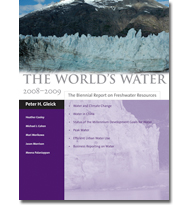
The World's Water 2008-2009 is now available
The much anticipated sixth volume in the highly regarded series, The World’s Water 2008-2009, is now available. Produced by the Pacific Institute.
Also see an update on the Water Conflict Chronology.
Organizations: Engineers Without Borders
 Engineers Without Borders - USA is a non-profit humanitarian organization established to partner with developing communities worldwide in order to improve their quality of life. This partnership involves the implementation of sustainable engineering projects, while involving and training internationally responsible engineers students.
People helping to solve the problem

Water For People helps people in developing countries improve their quality of life by supporting the development of locally sustainable drinking water resources, sanitation facilities and health and hygiene education programs.
Around the world, 884 million people do not have access to safe drinking water and 2.5 billion are without adequate sanitation facilities. Every day, nearly 6,000 people who share our planet die from water-related illnesses, and the vast majority are children.
Their vision is a world where all people have access to safe drinking water and sanitation; a world where no one suffers or dies from a water- or sanitation-related disease.
UN Millennium Goal #7: Ensure Environmental Sustainability

Target 7.A: Integrate the principles of sustainable development into country policies and programmes and reverse the loss of environmental resources
Target 7.B: Reduce biodiversity loss, achieving, by 2010, a significant reduction in the rate of loss
Target 7.C: Halve, by 2015, the proportion of people without sustainable access to safe drinking water and basic sanitation
Target 7.D: By 2020, to have achieved a significant improvement in the lives of at least 100 million slum dwellers
Read more about Goal #7
Subscribe to:
Posts (Atom)

 Posts
Posts

